A volatile July, a broader market. Market leadership broadened even as inflation, rates and geopolitical risks weighed on sentiment.
KEY OBSERVATIONS
Volatility rising – July was a volatile month as investors weighed strong corporate earnings against renewed concerns about AI-related valuations, heavy capital spending, and the durability of the recent growth-led rally.
Ready set pause – The Federal Reserve held rates steady at 3.50% to 3.75%, but three dissents in favor of a hike and a continued focus on elevated inflation pushed Treasury yields higher and pressured rate-sensitive areas of the market.
Value takes the lead – Market leadership continued to broaden as value-oriented sectors, real assets, and select non-U.S. equities held up better than mega-cap growth, while Middle East tensions and higher oil prices reinforced the importance of diversified portfolio exposures.
RECAP
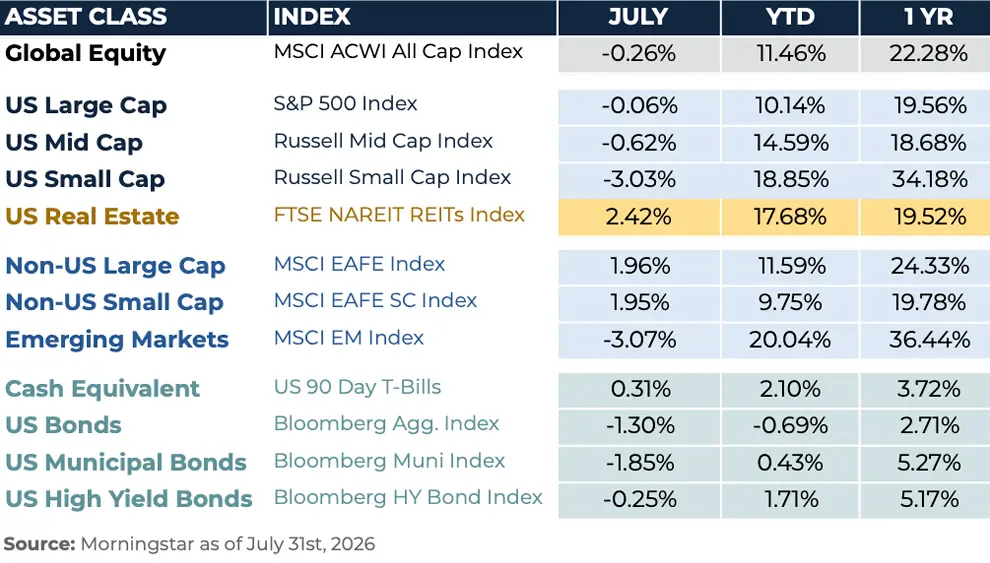
July served as a reminder that markets continue to navigate a complex environment where economic resilience, persistent inflation pressures, evolving monetary expectations, and geopolitical developments all compete for investor attention. An escalation in tensions involving Iran contributed to higher energy prices and increased volatility late in the month, while investors also digested another Federal Reserve meeting with mixed signals and lack of clarity on the direction of policy. The Federal Open Market Committee voted to keep the federal funds rate unchanged at 3.50% to 3.75%, though a notable number of policymakers favored tighter policy, leading Treasury yields to move higher and weighing on interest rate sensitive asset classes.
U.S. equities finished modestly lower but performance broadened beneath the surface. The S&P 500 declined 0.1% for the month, giving back a portion of its strong year-to-date gains, while the Russell 2000 fell 3.0% as rising bond yields and tighter financial conditions created a headwind for smaller cap companies. The market's leadership continued to rotate away from some of the largest growth-oriented stocks that had led earlier in the year, while investors favored sectors tied to energy, financials and more value-oriented areas of the market. Real assets were among the strongest performers during the month. The FTSE NAREIT All Equity REITs Index gained 2.4%, supported by continued strength in data center, industrial and specialized property sectors.
International developed equities delivered positive results despite the uncertain environment. The MSCI EAFE Index gained 2.0%, supported by strength across parts of Europe and the United Kingdom, where equity markets benefited from relatively attractive valuations. A weaker U.S. dollar also provided a modest tailwind for U.S.-based investors. Emerging markets faced a more difficult month. The MSCI Emerging Markets Index declined 3.1%, driven largely by weakness in several technology-heavy Asian markets as investors reassessed growth expectations and semiconductor-related shares experienced a significant pullback after a strong first half of the year.
Fixed income markets struggled as yields moved higher following the July FOMC meeting. The Bloomberg U.S. Aggregate Bond Index fell 1.3%, reflecting pressure across both Treasury and investment-grade corporate bonds. The market had mixed interpretation of the Fed's messaging, particularly with inflation remaining above target and energy prices rising amid Middle East tensions. Credit markets proved relatively resilient. The Bloomberg U.S. Corporate High Yield Index slipped just 0.2%, as healthy corporate fundamentals and limited default activity helped offset the impact of rising rates.
OUTLOOK
This year has reinforced the importance of remaining diversified as market leadership continued to broaden beyond the largest U.S. companies. The strong relative performance of small and mid-cap equities year to date supports a key theme present across client portfolios which seeks to capture opportunities beyond simply the largest AI beneficiaries. As AI-related investment spreads across the economy, smaller companies, non-U.S. equities and real assets may all play a role in the next phase of the cycle. With valuations still elevated in parts of the market, interest rates elevated and geopolitical risks unresolved, we continue to favor balanced portfolios that can participate in broadening market leadership while maintaining exposure to high-quality managers and diversifying asset classes.