No summer break for the bond market. Hawks soar in Jackson Hole as Treasury policy increases volatility in markets.
KEY OBSERVATIONS
Volatility rising – August was a constructive but uneven month as investors balanced resilient equity returns against renewed pressure in the Treasury market.
Hawkish tone – Federal Reserve’s message grew more hawkish following Jackson Hole, pushing short-term yields higher and reinforcing that policy uncertainty remains a key driver of fixed income volatility.
Tensions persist – Geopolitical tensions remained a key source of market volatility, with U.S.-Iran hostilities lifting oil prices and supporting commodities as investors sought protection from supply risks and broader uncertainty.
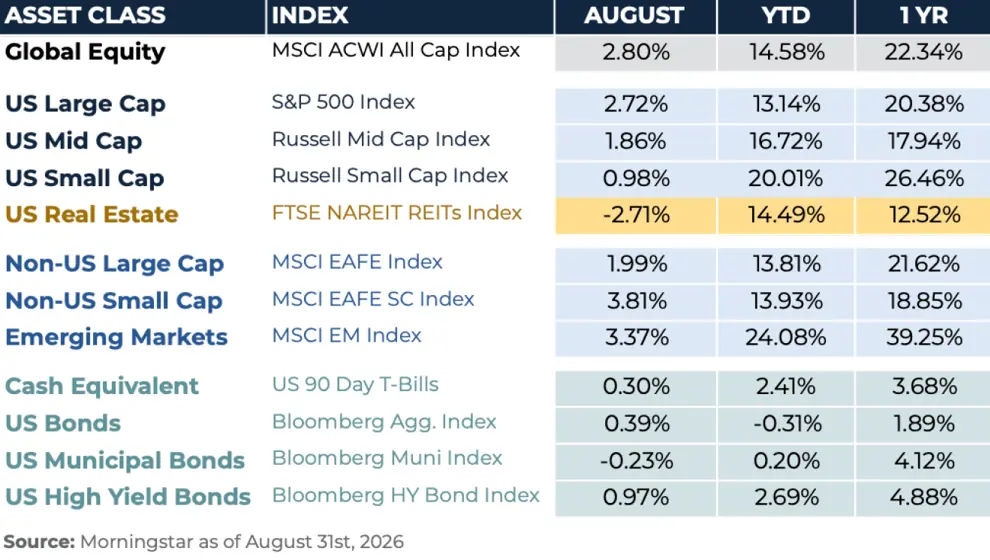
RECAP
August kept investors on their toes, balancing familiar narratives from the year: resilient growth, sticky inflation, a Federal Reserve unwilling to commit to a direction, and a Middle East conflict that refuses to settle. The Federal Reserve’s tone grew more hawkish as the month progressed. At the Jackson Hole symposium late in the month, Fed Chair Kevin Warsh aimed to build credibility with markets, warning that the summer's softer inflation readings did "not tell me that underlying trends have meaningfully improved," signaling that rates could move higher. Markets repriced quickly. The odds of a September rate hike jumped from roughly one-in-three to better than half, the 10-year Treasury yield climbed above 4.7%, and the 30-year reached its highest level since 2007. Late in the month, renewed U.S. and Iran hostilities around the Strait of Hormuz pushed oil higher and added a fresh layer of volatility.
International markets participated in the rally. The MSCI EAFE Index returned 2.0%, supported by firmer economic activity in parts of Europe and the United Kingdom and helped by a modestly weaker U.S. dollar. Emerging markets led the developed world once again. The MSCI Emerging Markets Index gained 3.4%, powered by strength in technology-heavy Asian markets, particularly South Korea and Taiwan, alongside a firm bid for materials tied to rising commodity prices. The asset class is now up 24.1% year-to-date.
Fixed income proved resilient even as yields pushed modestly higher on the front end of the curve. The Bloomberg U.S. Aggregate Bond Index returned 0.4%, as attractive starting yields cushioned the impact. The rate move accelerated after Jackson Hole, with short-dated yields rising most as investors priced in a firmer Fed, building on a mid-month catalyst when the Treasury announced that it would increase its long-end buyback operations beginning in September. Credit held up well. The Bloomberg U.S. Corporate High Yield Index gained 1.0%, as healthy fundamentals and tight spreads kept the sector firmly in positive territory.
OUTLOOK
August reinforced that investors continue to navigate a market shaped by resilient growth, elevated rates, persistent inflation concerns and unresolved geopolitical risks. While equities have broadened and select risk assets have continued to participate in the rally, the bond market’s recent volatility underscores that the path forward may remain uneven as markets reassess the balance between income, duration risk and policy uncertainty. We continue to favor balanced portfolios that can participate in a broader opportunity set while emphasizing diversification, quality and thoughtful fixed income positioning, as higher yields once again provide meaningful income but require greater selectivity.