Key Takeaways
Midterm elections are often referendums on the incumbent party with congressional power flipping.
Despite strong economic growth and a stable job market, issues such as affordability, the buildout of data centers and the conflict in Iran are weighing on voters.
The makeup of Congress will impact the policy agenda over the next two years, but earnings are the main driver of equity market returns.
Referendum on the President’s First Two Years in Office
During midterms, voters elect every member of the House of Representatives, and about one-third of the members of the Senate. A shift in power during midterm elections often reflects changing presidential approval early in a term, which can reduce support for the party in power and voter turnout, and this year is no exception. There is a very strong historical relationship between the president’s approval rating and the number of seats the president’s party loses in Congress. With Trump’s approval rating at 32%, near the weakest of his two terms in office as we head into the midterm elections, the chance of the Democrats winning both the House and the Senate is looking more plausible.
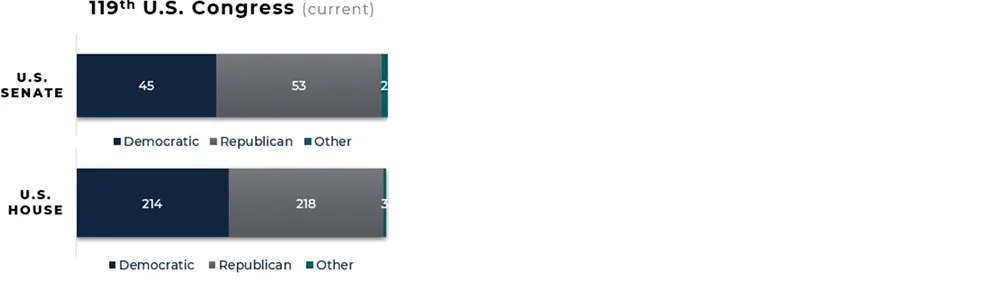
Republicans currently hold narrow majorities in both the Senate and the House of Representatives. The Democrats need to gain three seats to reach the 218-seat majority in the House. For the Senate, Democrats would need a net gain of four seats to reach the simple majority of 51 seats. Thirty-three Senate seats are up for re-election in addition to two special elections for the Senate seats vacated by Marco Rubio (Republican, Florida) and JD Vance (Republican, Ohio).
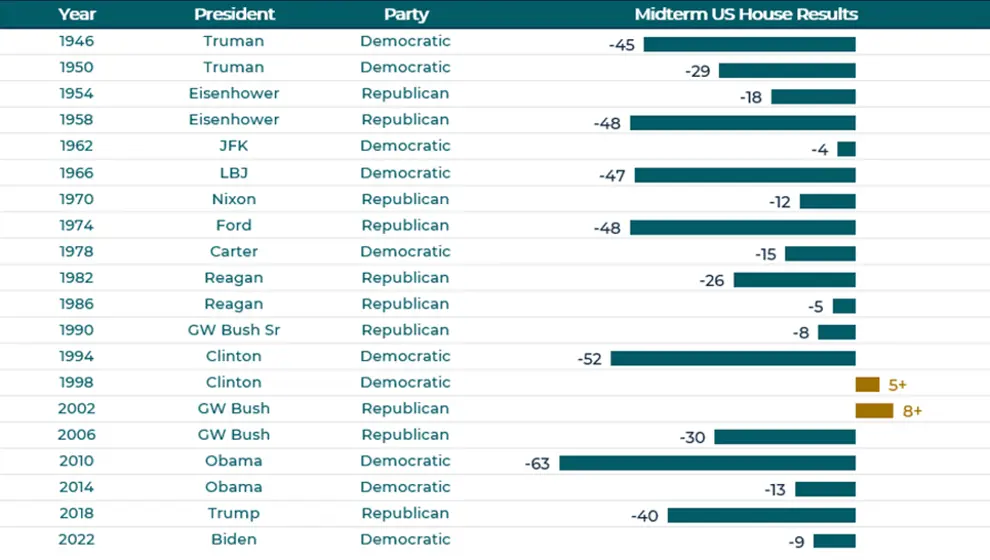
Historically, the incumbent party has frequently been at a structural disadvantage, with midterm elections often viewed as a referendum on the prevailing sentiment. In fact, only two midterms since 1946 delivered House gains for the president’s party. The median midterm results in a roughly 22‑seat loss for the party that holds the presidency.
A Source of Volatility
On average, midterm election years have historically tended to follow a similar pattern: choppy trading and weakness in the months leading up to the election, followed by a stronger and more sustained advance once the results are known. Midterm election years often bring elevated policy uncertainty. With this backdrop, equity markets have historically struggled, followed by a recovery after the results of the elections become known. By contrast, 2026 has tracked much stronger than the historical playbook, with equities posting gains despite the backdrop of higher oil prices, elevated bond yields and political uncertainty. Still, with Treasury yields near cycle highs and control of power still up for grabs, the market could yet see volatility emerge before any post-election relief rally takes hold.
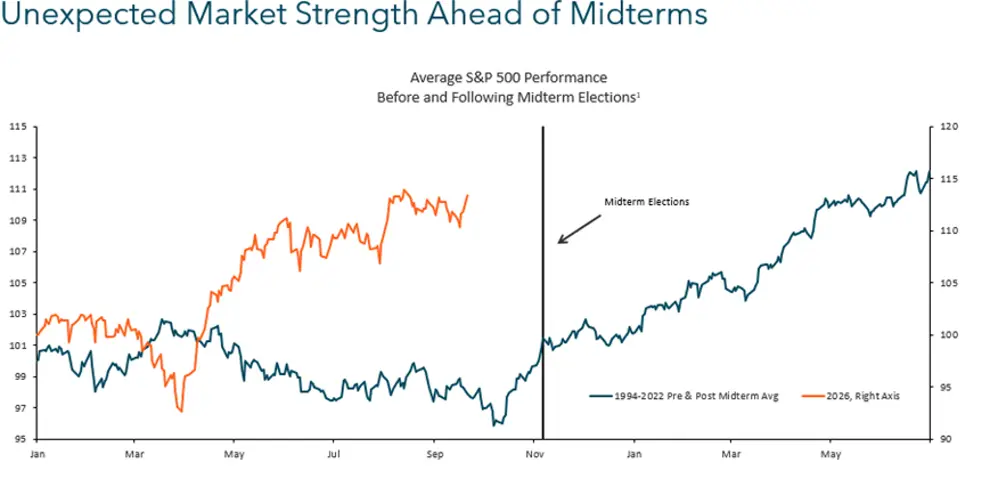
1 Midterm election years: (1994, 1998, 2002, 2006, 2010, 2014, 2018, 2022) Source: Strategas. As of September 21st, 2026. Past performance is no guarantee of future results.
Markets have often rallied the year after midterm elections as political uncertainty subsides. What happens after the votes are counted has been far more encouraging, with one-year equity returns following Election Day averaging nearly 15% since 1942.
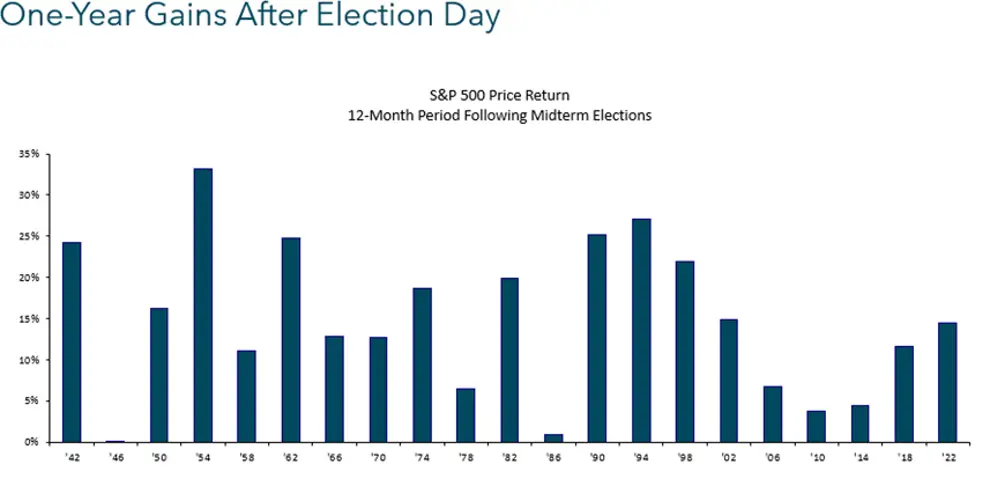
1 Source: Strategas. S&P 500 data sourced from FactSet. Data as of September 21st, 2026. Past performance is no guarantee of future results.
The November 3rd elections will decide control of a closely divided Congress. So far, market volatility has been rather muted, as strong earnings and AI investment has overwhelmed rising inflationary pressure and general political uncertainty. That said, we would not be surprised by a bumpier path in the weeks ahead as surprise developments with Iran could quickly tip the scales in either direction. Even so, we would caution against making portfolio decisions based on anticipated election outcomes. Over any meaningful horizon, earnings, interest rates, and the discipline of a well-built plan matter far more than which party controls Congress. We are approaching the calendar with the same principles that served our clients through this year’s twists: stay balanced, own the income that higher yields now provide and diversify globally.